The Myth of the Perfect Tennis Viewing Position
The perfect tennis viewing position does not exist. Compare baseline, sideline, and elevated seats to choose what helps you follow a match.
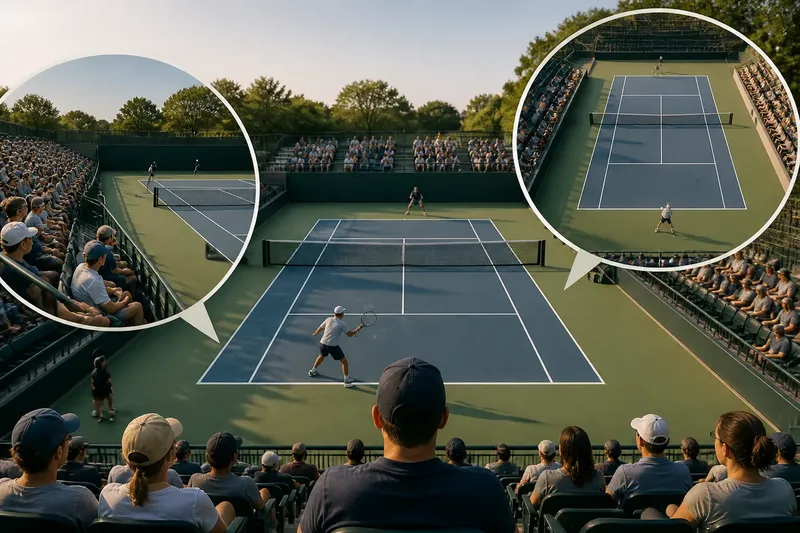
You settle into a seat behind the baseline just as a rally begins. The players’ spacing looks clear, but the ball seems to vanish against the far court. Move to the sideline and the ball’s flight becomes easier to track, while the depth of each shot feels harder to judge. The perfect tennis viewing position is a myth: every angle makes some parts of a match clearer and leaves others less obvious.
That trade-off matters whether you are choosing a ticket, watching from a club fence, or deciding where to stand during a changeover. Rather than searching for one seat that reveals everything, match your position to what you most want to notice. Three common options offer distinct views.
What does a baseline seat show?
A seat behind a baseline gives you a view along the court’s length. You can compare how deep shots land, watch players recover toward the middle, and see the geometry of crosscourt exchanges. The court’s symmetry is easy to read, which helps when you are still learning where players tend to move after a shot.
The angle can also make serves and returns feel direct: you see the server’s position, the receiver’s stance, and the ball traveling toward the service box. But the ball may appear to travel straight at you or away from you, making its sideways curve difficult to read. Players can also overlap from this viewpoint, especially near the far end, and the net can partly obscure a low ball.
This position suits viewers who like tracking depth, court coverage, and the patterns linking one shot to the next. It is less helpful if your main interest is judging how wide a shot goes or seeing the shape of a player’s swing from the side.
What changes from a sideline seat?
From the side, the court’s width and the ball’s lateral movement are easier to follow. You can see a crosscourt shot travel across the frame and compare the players’ positions relative to one another. The net, service line, and sidelines also provide useful visual references as the rally unfolds.
Depth is the trade-off. A ball heading toward the far baseline can appear to skim along the court from a side-on angle, so its landing point may be difficult to judge. Players at opposite ends can look compressed together, and a player standing between you and the ball may briefly block your view.
A sideline seat often suits someone who wants to follow shot direction, movement across the court, and the players’ movement mechanics. Choose it if the visual flow of a rally matters more to you than seeing the court’s length in a symmetrical layout.
Does an elevated seat change the match?
An elevated position adds a broader view of the court. From above, player spacing, open areas, and movement after each shot can become easier to understand. You may notice when a player leaves a section exposed or when both players repeatedly return to familiar positions.
Height does not make every detail clearer. The ball can be small against the court, and facial expressions or fine contact details are difficult to make out from farther away. Depending on the seat, the angle may also flatten the apparent height of a shot or make the net and far baseline seem unusually close together.
This view suits spectators who enjoy reading tactics and patterns across the whole court. It can be a good choice when you want to understand where players are moving rather than concentrate on the precise shape of one stroke.
Which tennis viewing position fits your priorities?
Choose by naming the detail you most want to follow, then accept the blind spot attached to it. A seat cannot make the ball’s depth, width, speed, and contact point equally legible at once. Your familiarity with tennis matters, too: a broad view may help you read player movement, while a more level view may make the ball’s route feel easier to track.
- Choose behind the baseline if you want to see depth, recovery position, and the relationship between serve and return.
- Choose the sideline if you want a strong sense of width, crosscourt direction, and movement from one side of the court to the other.
- Choose an elevated seat if you want to observe spacing and how players use open court.
- Check the court layout before choosing a side seat; corners, barriers, and nearby structures can affect what remains in view.
- Consider the match’s setting if your priority is following the ball throughout a rally. A comfortable, unobstructed view may matter more than a theoretically ideal angle.
Say you are choosing between a seat behind the baseline and one at midcourt on the sideline, and your main question is why a player keeps moving toward one corner. The sideline view may make those lateral shifts easier to follow, while a baseline seat would show depth and recovery more clearly. The expected observable difference is what catches your eye: side-to-side movement from one seat, court length from the other.
What viewing position questions do spectators ask?
Is a seat behind the baseline best for watching serves?
It gives you a direct view of the server and receiver, along with the ball’s route toward the service box. A side view can make the ball’s direction across the court easier to see, so the better choice depends on which part of the serve you want to follow.
Can you judge whether a ball landed in from the stands?
Some angles make a landing look clearer than others, but distance and perspective can still obscure the exact spot. Use the official calls and court markings rather than treating your seat’s view as decisive.
Is an elevated seat better for understanding tactics?
It can help you see player spacing and open areas across the court. It may be less suitable if you want to watch fine contact details or follow a small, fast-moving ball closely.
Should beginners choose one particular side of the court?
There is no required beginner seat. A baseline view can make court depth and recovery positions easier to grasp, while a sideline view can clarify shot direction; choose whichever makes the match easier for you to follow.
How can you use perspective while watching?
Let the view guide your attention instead of asking it to show everything. From behind the baseline, notice whether a player recovers after hitting deep. From the sideline, watch how a crosscourt shot changes the other player’s position. From above, look at how much court remains open after each exchange.
When you watch the same type of rally from different places, the apparent shape of the play can change without the players doing anything differently. That is useful: it reminds you that a spectator sees an angle, not the whole court from every direction.
The best tennis viewing position is the one that makes the detail you care about easiest to follow, with a blind spot you can live with. If you get another chance to watch, try a different angle and compare what you notice. The changed view can make a familiar match feel newly legible.